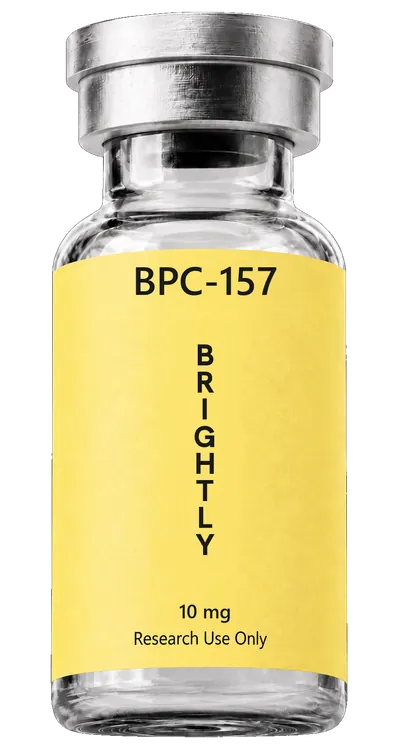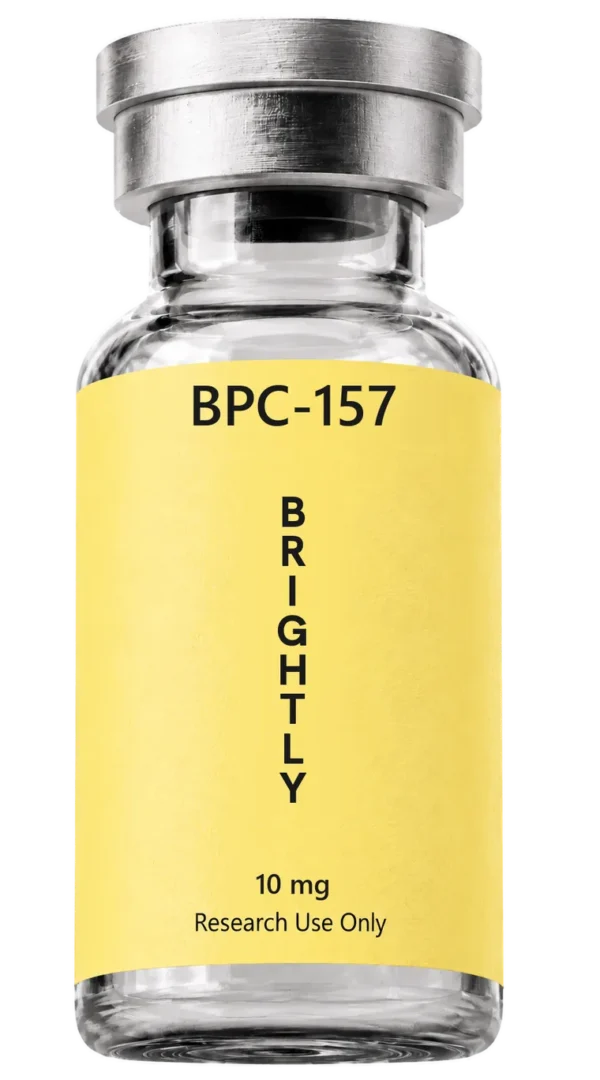
BPC-157
For research use onlyCAS 137525-51-0
A synthetic 15-amino-acid research peptide.
Mass (mg)
Bundle & Save
Frequency


before 1:00 PM CT
money-back
on orders $50+
Stable synthetic peptide. BPC-157 is a synthetic 15-residue peptide that corresponds to a partial sequence first identified in gastric juice, reproduced synthetically to a defined specification rather than isolated from any biological source. The pentadecapeptide chain is noted across the published literature for its stability under varied laboratory conditions, which is part of why it is used as a reference material in several distinct research areas. Brightly supplies it as a lyophilized (freeze-dried) powder in a sealed, tamper-evident vial, prepared and handled strictly as a characterised reference material for in-vitro laboratory research.
The characterisation below summarises the properties that define the material as supplied and distinguish a defined synthetic peptide from variable biological material:
| Property | Characterisation |
|---|---|
| Origin | Fully synthetic; partial sequence identified in gastric juice |
| Length | 15 residues (pentadecapeptide) |
| Molecular formula | C62H98N16O22 |
| Stability profile | Reported as stable across varied laboratory conditions |
| Supplied form | Lyophilized powder, nitrogen-sealed vial |
Because each vial contains a single, defined sequence rather than a mixture, BPC-157 gives researchers a consistent reference point across tissue-repair, gastrointestinal, and angiogenesis studies. A characterised, lot-verified peptide supports reproducible in-vitro and preclinical work, where variability in the test article would otherwise confound interpretation of the results.
Supplied strictly as a characterised reference material for in-vitro and preclinical laboratory work, not for any diagnostic or therapeutic purpose.
| Peptide class | Synthetic peptide |
|---|---|
| Molecular formula | C62H98N16O22 |
| Molecular weight | 1419.53 g/mol |
| CAS number | 137525-51-0 |
| Sequence | Gly-Glu-Pro-Pro-Pro-Gly-Lys-Pro-Ala-Asp-Asp-Ala-Gly-Leu-Val (15 residues) |
| Purity | ≥99% (HPLC) |
| Form | Lyophilized powder |
| Quantity | 10 mg per vial |
| Testing | HPLC, endotoxin (LAL), microbial DNA (PCR), third-party |
| Documentation | Certificate of Analysis included |
| Storage | −20°C, protect from light |
| Application | Research use only |
Research overview
BPC-157 is supplied as a characterised reference material for controlled in-vitro and preclinical laboratory work. It is synthesised and purified to industry-standard protocols, making it suitable for analytical testing, tissue-repair models, and experimental cytoprotection studies. Every lot is verified by HPLC for purity and identity, with a lot-specific Certificate of Analysis included.
Research-grade standards behind each batch
- Synthesised via solid-phase peptide synthesis (SPPS)
- Purified using preparative HPLC
- Verified through analytical quality-control procedures
- Screened for endotoxins by LAL
- Identity confirmed by HPLC
Why researchers study BPC-157
Published in-vitro and preclinical literature examines this pentadecapeptide across several interconnected repair and protection processes, which makes it of interest as a tool compound for studying how tissues respond to injury under controlled conditions. Areas of scientific interest include:
- Tissue-repair models
- Gastrointestinal mucosal-integrity studies
- Angiogenesis and endothelial-signaling pathways
- Tendon and ligament repair models
- Cytoprotection mechanisms
- Cell-migration and growth-factor investigations
Reported mechanisms of interest
Across the published preclinical record, BPC-157 is studied for its association with angiogenic signaling, including pathways linked to vascular endothelial growth factor receptor 2 (VEGFR2), and with the nitric-oxide (NO) system. These are described strictly as areas of scientific interest observed in laboratory models, not as established effects.
Angiogenic signaling. Studied for reported associations with endothelial cell migration, tube-formation assays, and VEGFR2-linked pathways in in-vitro angiogenesis models.
Cytoprotection and mucosal integrity. Studied in gastrointestinal models for its reported relationship to mucosal-integrity endpoints and epithelial-barrier research.
Connective-tissue repair. Examined in tendon-, ligament-, and muscle-derived cell models as a reference peptide for repair-oriented research.
Synthetic reference material vs native source
| Characteristic | BPC-157 (as supplied) | Native gastric-juice context |
|---|---|---|
| Origin | Fully synthetic | Identified in gastric juice |
| Composition | Defined 15-residue sequence | Partial sequence within a complex biological matrix |
| Batch consistency | Lot-verified by HPLC and MS | Not standardised |
| Supplied form | Characterised reference material | Not isolated as a reference standard |
Supplied strictly as a characterised reference material for in-vitro and preclinical laboratory work, not for any diagnostic or therapeutic purpose.
Every lot of BPC-157 follows a controlled, pharma-grade workflow from synthesis to fulfilment, so the material stays consistent, pure, and stable.
- Cleanroom manufacturing
- Synthesised in controlled, low-contamination environments for batch-to-batch consistency.
- Verified HPLC-verified purity
- Purity confirmed by high-performance liquid chromatography (HPLC).
- Verified identity & purity
- Identity and purity confirmed by HPLC, and endotoxin by Limulus Amebocyte Lysate (LAL).
- Endotoxin-controlled
- Low endotoxin levels matter in sensitive cell-based and signaling studies, where inflammatory contaminants could confound results.
- Pharma-grade raw materials
- Synthesis begins with tested amino acids and validated reagents to protect molecular integrity.
- Lyophilized for stability
- Freeze-drying preserves structural integrity during shipping, storage, and handling.
- Nitrogen-sealed vials
- Vials are sealed under nitrogen to limit exposure to oxygen and moisture.
Understanding lyophilization. Freeze-drying removes moisture by freezing the material and lowering pressure so water sublimates directly from solid to vapour, leaving a stable, dry powder that tolerates storage well for long-term studies.
Before reconstitution. Unopened lyophilized BPC-157 tolerates short periods at room temperature in a cool, dry place away from heat, humidity, and light. For longer storage, keep sealed vials frozen: −20 °C is common, while −80 °C adds margin for long-term or archival storage.
After reconstitution. Reconstitute with bacteriostatic water, then keep the solution refrigerated below 4 °C, aliquot to working volumes, and avoid repeated freeze-thaw cycles. Under appropriate laboratory conditions, reconstituted solutions typically remain stable for up to 30 days, following your own laboratory protocol.
- Same-day dispatch (USA)
- In-stock orders placed before 1:00 PM CT ship the same business day.
- Fast domestic delivery
- Free FedEx shipping on every order; express delivery is free on orders over $150.
- Protective handling
- Vials are held in temperature-controlled storage before shipment; the lyophilized powder is stable for ambient transit and is packed to limit temperature swings, moisture, and physical damage.
- Tracking and guarantee
- Tracking is provided at shipment, and every order is backed by our 30-day money-back guarantee.
For research use only. Not for human or animal consumption.
Accredited.
Researchers’ go-to, nationwide.
Frequently Researched Together
Popular pairings from the Brightly range