NAD+
For research use onlyA pyridine dinucleotide coenzyme research compound.
Mass (mg)
Bundle & Save
Frequency


before 1:00 PM CT
money-back
on orders $50+
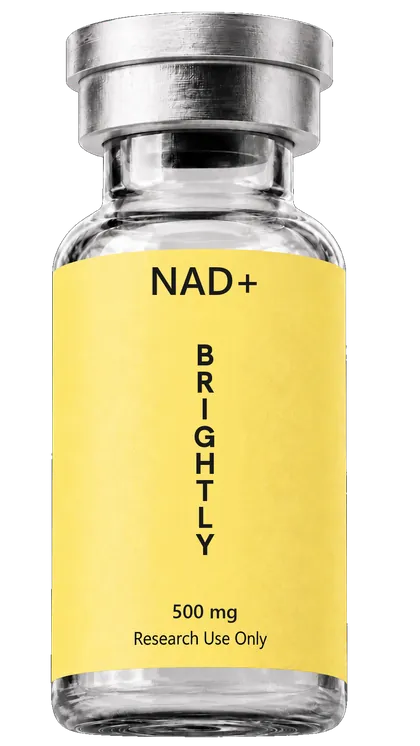
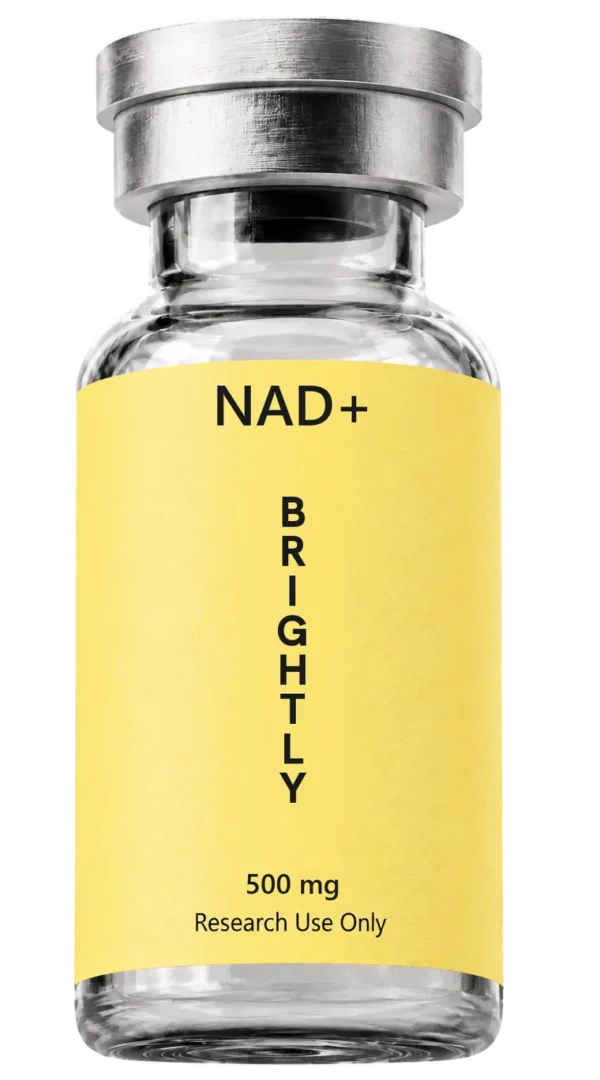
Pyridine dinucleotide coenzyme. NAD+ (nicotinamide adenine dinucleotide, oxidised form) is a coenzyme: two nucleotides, one carrying nicotinamide and the other adenine, joined through a pair of bridging phosphate groups. It is the one non-peptide material in the Brightly catalog, and it is characterised accordingly, by molecular structure rather than by amino-acid sequence. Brightly supplies it as a lyophilized (freeze-dried) powder in a sealed, tamper-evident vial, prepared and handled strictly as a characterised reference material for in-vitro laboratory research.
NAD+ is one half of a redox pair, and which half you have is the defining property of the material as supplied:
| Property | NAD+ (as supplied) | NADH |
|---|---|---|
| Redox state | Oxidised | Reduced |
| Role in the pair | Electron acceptor | Electron donor |
| Nicotinamide ring | Positively charged | Neutral |
| Supplied form | Lyophilized powder, nitrogen-sealed vial | – |
Because each vial contains a single, defined compound at a verified purity rather than a mixture of redox states, NAD+ gives researchers a consistent reference point for redox-biology and enzyme-cofactor work, where an uncertain NAD+/NADH ratio in the test article would confound the measurement being made.
Supplied strictly as a characterised reference material for in-vitro and preclinical laboratory work, not for any diagnostic or therapeutic purpose.
| Compound class | Pyridine dinucleotide coenzyme |
|---|---|
| Molecular formula | C21H27N7O14P2 |
| Molecular weight | 663.43 g/mol |
| CAS number | 53-84-9 |
| Structure | Nicotinamide mononucleotide linked to adenosine monophosphate |
| Redox state | Oxidised (NAD+) |
| Purity | ≥99% (HPLC) |
| Form | Lyophilized powder |
| Quantity | 500 mg per vial |
| Testing | HPLC, endotoxin (LAL), microbial DNA (PCR), third-party |
| Documentation | Certificate of Analysis included |
| Storage | −20°C, protect from light |
| Application | Research use only |
Research overview
NAD+ is supplied as a characterised reference material for controlled in-vitro and preclinical laboratory work. It is manufactured and purified to industry-standard protocols, making it suitable for analytical testing, enzyme-cofactor assays, and experimental bioenergetics models. Every lot is verified by HPLC for purity and identity, with a lot-specific Certificate of Analysis included.
Research-grade standards behind each batch
- Manufactured by controlled enzymatic and chemical synthesis
- Purified using preparative chromatography
- Verified through analytical quality-control procedures
- Screened for endotoxins by LAL
- Identity confirmed by HPLC
Why researchers study NAD+
Published biochemical literature describes NAD+ as a central redox cofactor and as a consumed substrate for several enzyme families,1 which makes it of interest both as an assay reagent and as a subject of study in its own right. Areas of scientific interest include:
- Redox biology and the NAD+/NADH ratio
- Mitochondrial bioenergetics
- Sirtuin-dependent deacetylation
- PARP-mediated DNA-repair pathways
- CD38 and NAD-glycohydrolase activity
- Cellular-senescence and ageing-biology models
Two distinct roles in the cell
NAD+ is studied along two separate lines, and the distinction matters when designing an experiment around it.
As a redox cofactor. NAD+ accepts a hydride to become NADH and is regenerated on the return leg, so it cycles rather than being consumed. This is the role it plays in glycolysis, the citric-acid cycle, and oxidative phosphorylation.
As a consumed substrate. Sirtuins, PARPs, and CD38 cleave NAD+ rather than cycling it, releasing nicotinamide. Because these enzymes deplete the pool, NAD+ availability is studied as a variable in its own right rather than as a fixed background quantity.
Coenzyme vs peptide reference materials
| Characteristic | NAD+ | Peptide reference materials |
|---|---|---|
| Molecule type | Dinucleotide coenzyme | Amino-acid chain |
| Characterised by | Molecular structure and formula | Amino-acid sequence |
| Manufacture | Enzymatic and chemical synthesis | Solid-phase peptide synthesis |
| Batch consistency | Lot-verified by HPLC and MS | Lot-verified by HPLC and MS |
| Supplied form | Lyophilized powder, nitrogen-sealed vial | Lyophilized powder, nitrogen-sealed vial |
Reference. Covarrubias AJ, Perrone R, Grozio A, Verdin E. NAD+ metabolism and its roles in cellular processes during ageing. Nat Rev Mol Cell Biol. 2021;22(2):119–141.
Supplied strictly as a characterised reference material for in-vitro and preclinical laboratory work, not for any diagnostic or therapeutic purpose.
Every lot of NAD+ follows a controlled, pharma-grade workflow from synthesis to fulfilment, so the material stays consistent, pure, and stable.
- Cleanroom manufacturing
- Produced in controlled, low-contamination environments for batch-to-batch consistency.
- ≥99% HPLC-verified purity
- Purity confirmed by high-performance liquid chromatography (HPLC).
- Verified identity & purity
- Identity and purity confirmed by HPLC, and endotoxin by Limulus Amebocyte Lysate (LAL).
- Endotoxin-controlled
- Low endotoxin levels matter in sensitive cell-based and enzyme assays, where inflammatory contaminants could confound results.
- Pharma-grade raw materials
- Synthesis begins with tested precursors and validated reagents to protect molecular integrity.
- Lyophilized for stability
- Freeze-drying preserves the compound during shipping, storage, and handling; NAD+ is hygroscopic and degrades in solution, so it is supplied dry.
- Nitrogen-sealed vials
- Vials are sealed under nitrogen to limit exposure to oxygen and moisture.
Understanding lyophilization. Freeze-drying removes moisture by freezing the material and lowering pressure so water sublimates directly from solid to vapour, leaving a stable, dry powder that tolerates storage well for long-term studies.
Before reconstitution. Unopened lyophilized NAD+ tolerates short periods at room temperature in a cool, dry place away from heat, humidity, and light. For longer storage, keep sealed vials frozen: −20 °C is common, while −80 °C adds margin for long-term or archival storage.
After reconstitution. Reconstitute with bacteriostatic water, then keep the solution refrigerated below 4 °C, aliquot to working volumes, and avoid repeated freeze-thaw cycles. Under appropriate laboratory conditions, reconstituted solutions typically remain stable for up to 30 days, following your own laboratory protocol.
- Same-day dispatch (USA)
- In-stock orders placed before 1:00 PM CT ship the same business day.
- Fast domestic delivery
- Free FedEx shipping on every order; express delivery is free on orders over $150.
- Protective handling
- Vials are held in temperature-controlled storage before shipment; the lyophilized powder is stable for ambient transit and is packed to limit temperature swings, moisture, and physical damage.
- Tracking and guarantee
- Tracking is provided at shipment, and every order is backed by our 30-day money-back guarantee.
For research use only. Not for human or animal consumption.