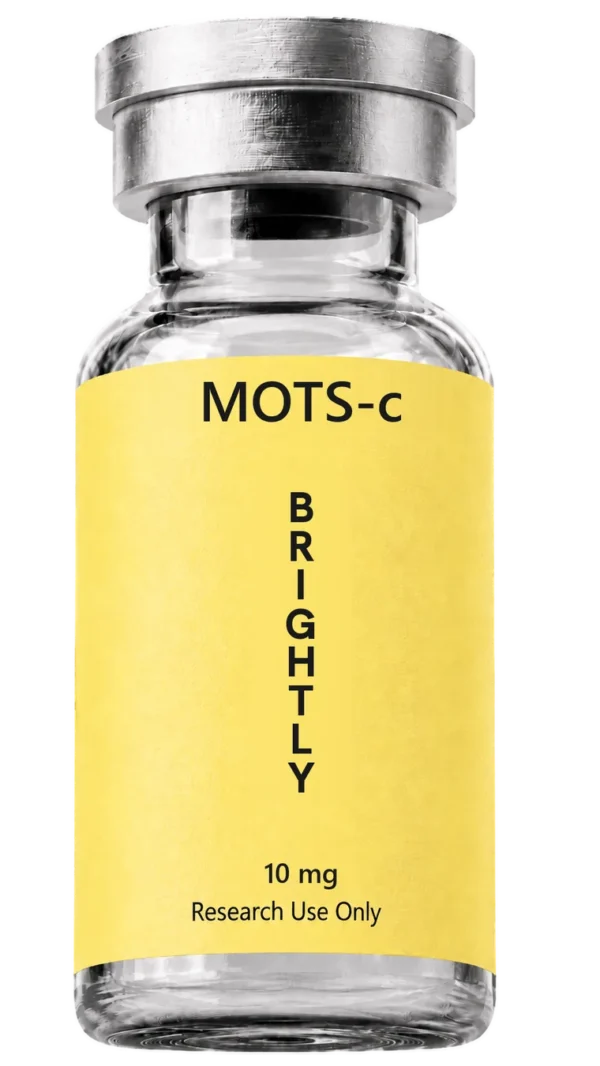
MOTS-c
For research use onlyCAS 1627580-64-6
A synthetic 16-amino-acid mitochondrial-derived research peptide.
Mass (mg)
Bundle & Save
Frequency


before 1:00 PM CT
money-back
on orders $50+

Mitochondrial-derived peptide. MOTS-c is a synthetic 16-residue peptide reproducing a sequence encoded within mitochondrial DNA rather than the nuclear genome. That origin is what defines the class: mitochondrial-derived peptides are short open-reading-frame products of the mitochondrial genome, and they are studied as signaling molecules in their own right rather than as incidental products of mitochondrial protein synthesis. Brightly supplies it as a lyophilized (freeze-dried) powder in a sealed, tamper-evident vial, prepared and handled strictly as a characterised reference material for in-vitro laboratory research.
The genome a peptide is encoded in is not a laboratory curiosity here; it is the reason the compound is studied at all, and it is what separates MOTS-c from the conventional signaling peptides elsewhere in the catalog:
| Property | Conventional signaling peptides | MOTS-c |
|---|---|---|
| Genome of origin | Nuclear DNA | Mitochondrial DNA |
| Class | Nuclear-encoded peptide | Mitochondrial-derived peptide (MDP) |
| Studied signaling direction | Cell-to-cell and receptor-mediated | Includes mitochondria-to-nucleus (retrograde) |
| Supplied form | – | Lyophilized powder, nitrogen-sealed vial |
Because each vial contains a single, defined 16-residue sequence rather than a mixture, MOTS-c gives researchers a consistent reference point for mitochondrial-signaling and cellular-energy work, where variability in the test article would otherwise confound interpretation of the results.
Supplied strictly as a characterised reference material for in-vitro and preclinical laboratory work, not for any diagnostic or therapeutic purpose.
| Peptide class | Mitochondrial-derived peptide |
|---|---|
| Molecular formula | C101H153N25O26S2 |
| Molecular weight | 2174.61 g/mol |
| CAS number | 1627580-64-6 |
| Sequence | 16-residue single chain (full sequence on the COA) |
| Purity | ≥99% (HPLC) |
| Form | Lyophilized powder |
| Quantity | 10 mg per vial |
| Testing | HPLC, endotoxin (LAL), microbial DNA (PCR), third-party |
| Documentation | Certificate of Analysis included |
| Storage | −20°C, protect from light |
| Application | Research use only |
Research overview
MOTS-c is supplied as a characterised reference material for controlled in-vitro and preclinical laboratory work. It is synthesised and purified to industry-standard protocols, making it suitable for analytical testing, mitochondrial-biology studies, and experimental metabolic models. Every lot is verified by HPLC for purity and identity, with a lot-specific Certificate of Analysis included.
Research-grade standards behind each batch
- Synthesised via solid-phase peptide synthesis (SPPS)
- Purified using preparative HPLC
- Verified through analytical quality-control procedures
- Screened for endotoxins by LAL
- Identity confirmed by HPLC
Why researchers study MOTS-c
Published in-vitro and preclinical literature describes mitochondrial-derived peptides as a distinct class of signaling molecules encoded by the mitochondrial genome,1 which makes them of interest for studying how mitochondria communicate with the rest of the cell. Areas of scientific interest include:
- Mitochondrial-to-nuclear (retrograde) signaling
- Cellular energy-sensing pathways
- Metabolic-stress response models
- One-carbon (folate-methionine) metabolism
- Mitochondrial-biology and bioenergetics investigations
- Peptide disposition and stability
Mitochondrial signaling
MOTS-c is studied for its association with several interlinked pathways in laboratory models. These are described strictly as areas of scientific interest observed in-vitro and in preclinical work, not as established effects.
Retrograde signaling. Studied for reported nuclear translocation under metabolic stress and for associations with stress-responsive nuclear gene expression, the pathway by which mitochondrial state is signalled back to the nucleus.
Energy-sensing pathways. Examined for reported associations with AMP-activated protein kinase (AMPK), the cellular energy sensor, in metabolic-signaling models.
One-carbon metabolism. Studied for reported associations with the folate-methionine cycle and with purine-biosynthesis intermediates in cultured cells.
Mitochondrial-derived vs nuclear-encoded peptides
| Characteristic | MOTS-c | Nuclear-encoded peptides |
|---|---|---|
| Encoded by | Mitochondrial genome | Nuclear genome |
| Peptide class | Mitochondrial-derived peptide | Conventional signaling peptide |
| Chain length | 16 residues | Varies |
| Batch consistency | Lot-verified by HPLC and MS | Varies by supplier |
| Supplied form | Characterised reference material | Varies |
Reference. Kim KH, Son JM, Benayoun BA, Lee C. The mitochondrial-encoded peptide MOTS-c translocates to the nucleus to regulate nuclear gene expression in response to metabolic stress. Cell Metab. 2018;28(3):516–524.
Supplied strictly as a characterised reference material for in-vitro and preclinical laboratory work, not for any diagnostic or therapeutic purpose.
Every lot of MOTS-c follows a controlled, pharma-grade workflow from synthesis to fulfilment, so the material stays consistent, pure, and stable.
- Cleanroom manufacturing
- Synthesised in controlled, low-contamination environments for batch-to-batch consistency.
- Verified HPLC-verified purity
- Purity confirmed by high-performance liquid chromatography (HPLC).
- Verified identity & purity
- Identity and purity confirmed by HPLC, and endotoxin by Limulus Amebocyte Lysate (LAL).
- Endotoxin-controlled
- Low endotoxin levels matter in sensitive cell-based and signaling studies, where inflammatory contaminants could confound results.
- Pharma-grade raw materials
- Synthesis begins with tested amino acids and validated reagents to protect molecular integrity.
- Lyophilized for stability
- Freeze-drying preserves structural integrity during shipping, storage, and handling.
- Nitrogen-sealed vials
- Vials are sealed under nitrogen to limit exposure to oxygen and moisture.
Understanding lyophilization. Freeze-drying removes moisture by freezing the material and lowering pressure so water sublimates directly from solid to vapour, leaving a stable, dry powder that tolerates storage well for long-term studies.
Before reconstitution. Unopened lyophilized MOTS-c tolerates short periods at room temperature in a cool, dry place away from heat, humidity, and light. For longer storage, keep sealed vials frozen: −20 °C is common, while −80 °C adds margin for long-term or archival storage.
After reconstitution. Reconstitute with bacteriostatic water, then keep the solution refrigerated below 4 °C, aliquot to working volumes, and avoid repeated freeze-thaw cycles. Under appropriate laboratory conditions, reconstituted solutions typically remain stable for up to 30 days, following your own laboratory protocol.
- Same-day dispatch (USA)
- In-stock orders placed before 1:00 PM CT ship the same business day.
- Fast domestic delivery
- Free FedEx shipping on every order; express delivery is free on orders over $150.
- Protective handling
- Vials are held in temperature-controlled storage before shipment; the lyophilized powder is stable for ambient transit and is packed to limit temperature swings, moisture, and physical damage.
- Tracking and guarantee
- Tracking is provided at shipment, and every order is backed by our 30-day money-back guarantee.
For research use only. Not for human or animal consumption.